3 Styles and How to Improve
Running Efficiency
Your running foot strike plays a key role in overall form and efficiency. Since gait varies from one runner to the next, taking the time to analyse your own foot strike could help prevent injuries and inefficiency during training.
There are three different types of running foot strikes: heel strike, midfoot strike and forefoot strike. Although we each have a natural tendency towards one style of foot strike, avoiding certain pitfalls can help maximize our potential as a runner.
What part of the foot should strike first when running?
Unfortunately, there is no single answer when it comes to the proper foot strike. Our individual style varies greatly depending on gait, so what works for one runner might be different for another.
However, there are a few general guidelines to keep in mind in order to maintain proper running form in your feet.
When your foot first strikes the ground, the majority of your foot placement should be under your hips. Landing too far forward or in front of your hips is more likely to strain your lower leg muscles.
In most cases, aiming to land towards the center of your foot, or running with a midfoot strike, will help minimize the stress on your lower leg muscles to reduce your chance of injury or heel spurs.
In order to evaluate your own foot strike and maintain proper running form, you’ll need to understand each of the three styles of foot strikes.
3 Running Foot Strike Styles

Heel Strike
This style of foot strike involves landing on the heel, or rear, of your foot – the first point to come in contact with the ground is your heel.
Heel strike running comes naturally to some runners who are taller and have a wider gait. However, landing on your heel can become a problem if you are over-striding and landing with your foot in front of your hips.
Midfoot Strike
This style of foot strike involves landing in the center, or midsection, of your foot – the first point to come in contact with the ground is the middle of your foot.
Running with a midfoot strike is often viewed as the healthiest form for your feet, as this foot strike usually creates the least amount of strain for your lower leg muscles.
However, if a midfoot strike causes you to bend your knee or lean forward past your hips, a different style of foot strike is most likely needed with your gait.
Forefoot Strike
This style of foot strike involves landing on the front of your foot, near the toes – the first point to come in contact with the ground is the top of your foot or the toes.
Running with a forefoot strike can often lead to a variety of issues, such as creating abnormal strain on your calves due to landing on or near your toes. A forefoot strike is the least common running foot strike, due to the fact that it feels unnatural for most runners.
3 Foot Landings During a Foot Strike
In addition to the different types of running foot strikes, there are also a few different foot landings that can occur with each step. If you are struggling to maintain proper running form in your feet but are already using the best foot strike for your gait, analyzing your landing may help clear up address any issues.
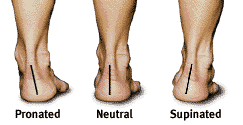
- Neutral – This occurs when the heel and toe are both straightforward when landing
- Supination – This occurs when the foot rolls outwards when landing
- Pronation – This occurs when the foot rolls inward, toward the arch, when landing

Going to a specialist running store will help in getting fitted for correct footwear to suit needs. However, I do believe supplementing your training by running bare feet on grass at easy pace regularly is very beneficial to strengthening the foot joints, bones, muscles, and helps enormously with posture. The most natural and simplest form of running is best if you can find a safe area to do so.
 PatrickDavorenCoaching.